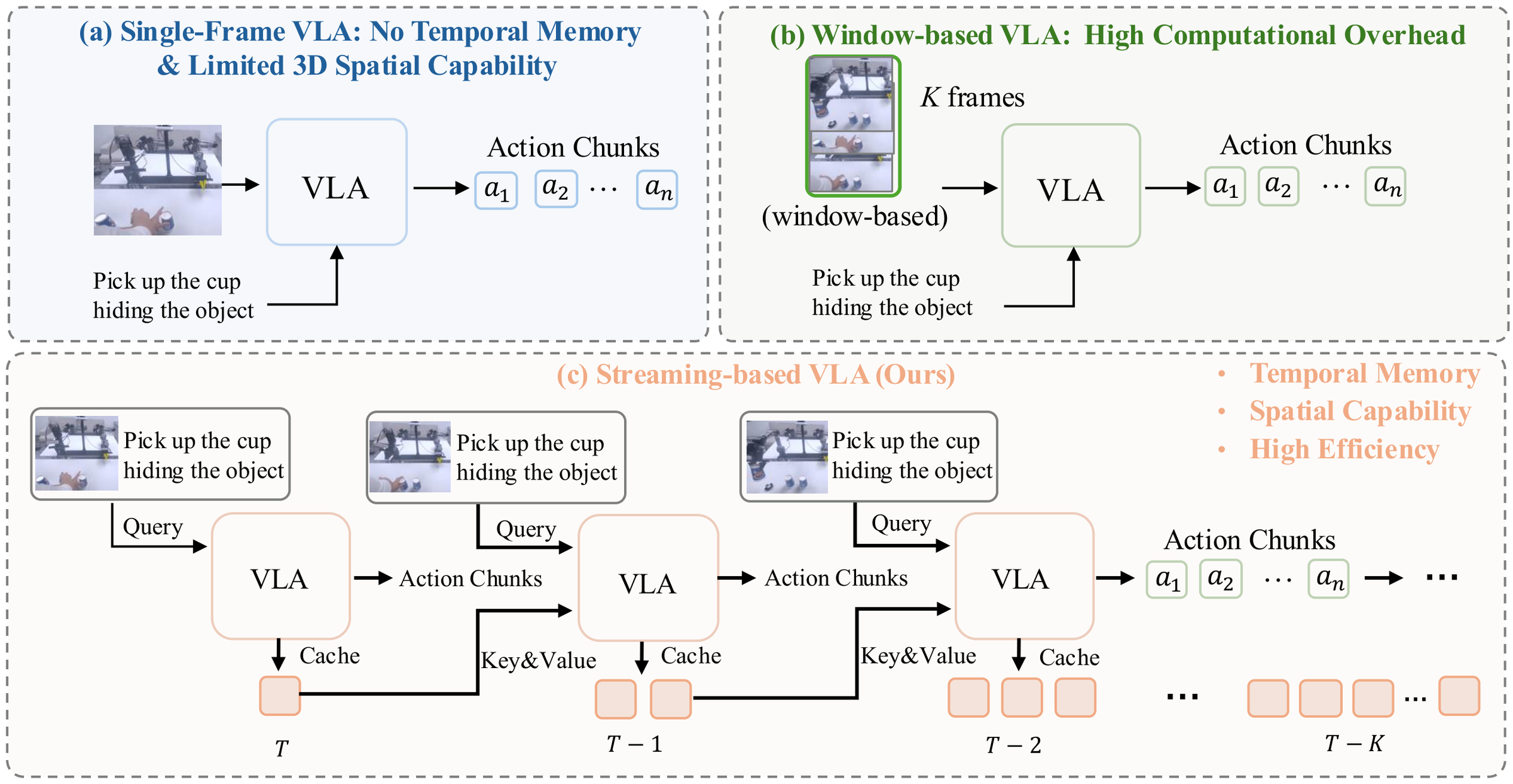
Vision-Language-Action (VLA) models have demonstrated effectiveness in robot manipulation, yet state-of-the-art models such as π0.5 operate under a single-frame paradigm, limiting their ability to retain past observations and develop precise spatial perception. In this paper, we propose StreamPI, a streaming multimodal temporal modeling framework that equips single-frame VLA with temporal reasoning capability without introducing any additional parameters. One core design is instruction-anchored temporal modeling. It treats each (visual observation, language instruction) pair as an atomic temporal unit: bidirectional attention within each pair enables cross-modal fusion, while causal attention across pairs preserves autoregressive streaming inference. This ensures the language instruction serves as a persistent semantic anchor throughout task execution. To bridge the gap between synchronous training and asynchronous real-robot deployment, we introduce a random-interval streaming training strategy: a proper inter-frame interval (e.g., every 3 frames) enables faster and smoother action execution. Beyond this, randomizing the interval further improves robustness to frame-timing perturbations, supporting asynchronous deployment in practice. Furthermore, by leveraging the length extrapolation capability of the LLM backbone, StreamPI seamlessly inherits pretrained single-frame weights and supports flexible single-frame and multi-frame inference. Experiments on real-robot tasks spanning memory-dependent and precise perception scenarios, as well as the simulation benchmark LIBERO, demonstrate that StreamPI outperforms π0.5 across diverse tasks.
Existing VLAs such as π0 and π0.5 operate in a single-frame paradigm: each action is predicted from one image observation without access to historical context. This design precludes two critical capabilities: memorizing and reasoning over past observations, and developing precise spatial perception through temporal aggregation. Incorporating temporal context is non-trivial because naive concatenation of frames causes sequence length to grow linearly, dilutes language instructions over long horizons, and introduces a mismatch between fixed-interval training and asynchronous real-robot deployment.
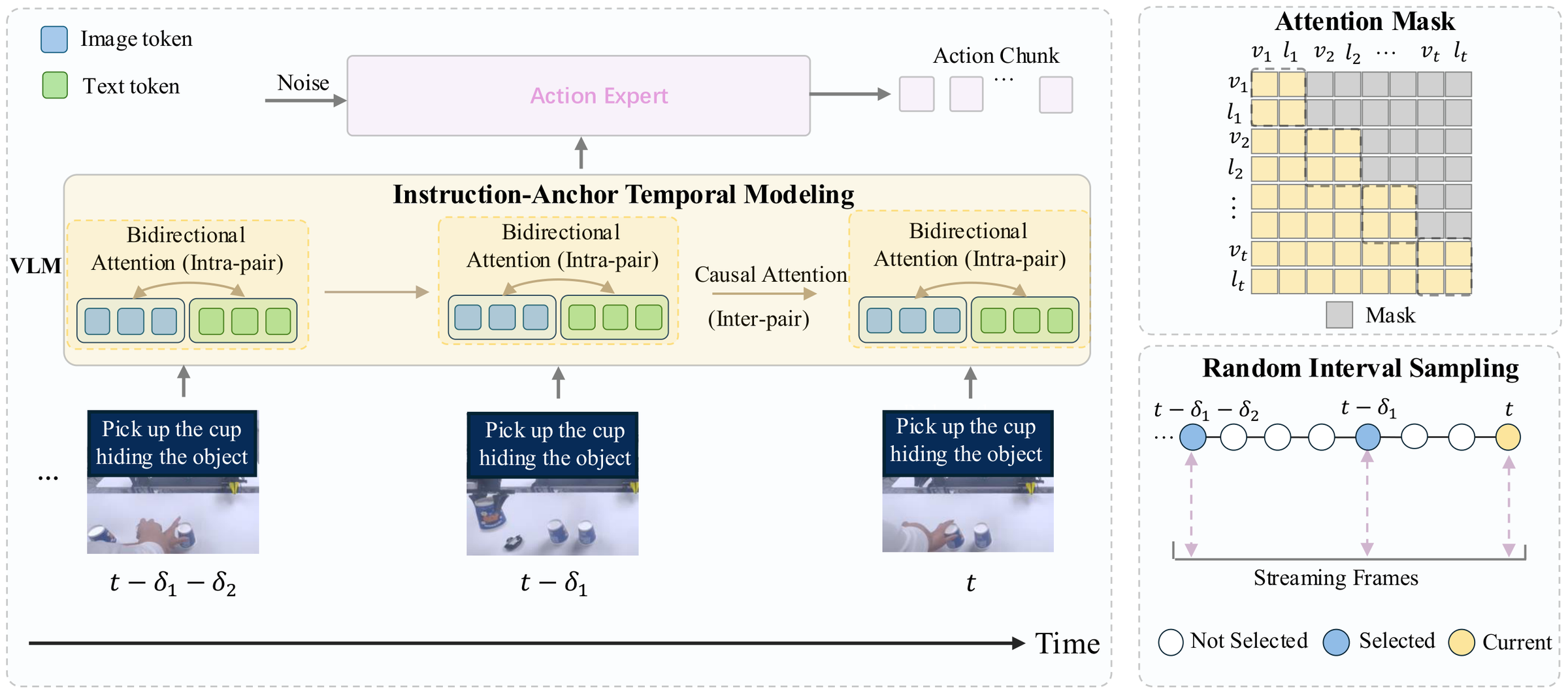
StreamPI treats each time step as an atomic temporal unit that jointly encodes multi-view visual observations and the language instruction:
ut = (Vt, lt)
Intra-pair bidirectional attention fuses visual tokens and the instruction within each unit: hτ = Attnbi(Vτ, lτ). Inter-pair causal attention then aggregates historical fused representations autoregressively: ot = Attncausal(ht−T+1, …, ht). Because the instruction is re-anchored to every observation, the model maintains persistent task awareness, and the hierarchical attention mask is implemented without any new parameters.
Real robots produce asynchronous observation streams with variable time gaps. During training, StreamPI independently samples the interval between adjacent historical observations from δi ∼ U[3, 7] and selects older observations using cumulative temporal offsets. A complementary temporal masking strategy randomly hides the earliest k frames, simulating the incremental observation pattern of streaming inference. Together, these mechanisms bridge the gap between synchronous training and asynchronous deployment.
At the initial timestamp, StreamPI encodes the current temporal unit, predicts an action chunk, and stores the resulting Key and Value representations. Each subsequent call encodes only the newly arrived unit, which attends to the cached history. The cache is bounded by the configured context length T and is flushed before the next unit would exceed that limit. This avoids repeatedly encoding past observations and keeps the additional streaming overhead modest as context grows.
We evaluate StreamPI on AgileX PiperX 6-DoF arms in an ALOHA-style leader-follower setup with one front-view Intel RealSense D455 and two wrist-mounted D435 cameras. Each task uses 100 teleoperated demonstrations collected at 30 FPS. Evaluation covers two complementary task categories. Precise perception-dependent tasks demand fine-grained geometric understanding, including Cup Insertion into Cup Sleeve and Pen Insertion into Narrow Bottle. Memory-dependent tasks require recalling information from earlier observations, including Rolling Object Grasping and Shell Game. As shown below, StreamPI substantially improves success rates over the single-frame π0.5 baseline across all four tasks.
Beyond real robots, we validate StreamPI on LIBERO, which comprises four suites of increasing complexity: LIBERO-Spatial, LIBERO-Object, LIBERO-Goal, and LIBERO-Long. StreamPI (T = 5) improves the average success rate from 96.9% to 98.3% over the single-frame π0.5 baseline, a gain of 1.4 points. The largest gains are on LIBERO-Goal (+2.8 points) and LIBERO-Long (+2.6 points), while LIBERO-Spatial remains tied at 98.8%.
| Method | Spatial | Object | Goal | Long | Avg. |
|---|---|---|---|---|---|
| Diffusion Policy | 78.3 | 92.5 | 68.3 | 50.5 | 72.4 |
| Octo | 78.9 | 85.7 | 84.6 | 51.1 | 75.1 |
| SpatialVLA | 88.2 | 89.9 | 78.6 | 55.5 | 71.7 |
| TraceVLA | 84.6 | 85.2 | 75.1 | 54.1 | 74.8 |
| OpenVLA | 84.7 | 88.4 | 79.2 | 53.7 | 75.9 |
| CoT-VLA | 87.5 | 91.6 | 87.6 | 69.0 | 81.1 |
| π0-FAST* | 96.4 | 96.8 | 88.6 | 60.2 | 85.0 |
| SmolVLA | 93.0 | 94.0 | 91.0 | 77.0 | 88.8 |
| GR00T-N1 | 94.4 | 97.6 | 93.0 | 90.6 | 93.9 |
| UniVLA | 95.4 | 98.8 | 93.6 | 94.0 | 95.4 |
| FLOWER | 97.1 | 96.7 | 95.6 | 93.5 | 95.7 |
| CronusVLA | 90.1 | 94.7 | 91.3 | 68.7 | 86.2 |
| TriVLA | 91.2 | 93.8 | 89.8 | 73.2 | 87.0 |
| 4D-VLA | 93.8 | 92.8 | 95.6 | 86.5 | 92.2 |
| CogACT | 87.5 | 90.2 | 80.2 | 53.2 | 77.8 |
| ST-π | 98.4 | 98.3 | 96.9 | 94.3 | 97.3 |
| MemoryVLA | 98.4 | 98.4 | 96.4 | 93.4 | 96.5 |
| π0 | 96.8 | 98.8 | 95.8 | 85.2 | 94.2 |
| π0.5 | 98.8 | 98.2 | 96.8 | 92.4 | 96.9 |
| StreamPI (T=3) | 98.6 | 98.6 | 98.6 | 93.8 | 97.5 |
| StreamPI (T=5) | 98.8 | 99.8 | 99.6 | 95.0 | 98.3 |
Table notes. Success rates (%) on LIBERO. Bold denotes the best result per column. StreamPI (T = 5) achieves the highest average success rate and the strongest long-horizon performance.
We further evaluate StreamPI on CALVIN (ABC→D), which measures long-horizon instruction following over chains of five consecutive tasks. StreamPI achieves an average chain length of 4.547, outperforming both the single-frame π0.5 baseline (4.313) and MemoryVLA (4.090), with the advantage growing as the chain progresses.
| Method | 1 | 2 | 3 | 4 | 5 | Avg. |
|---|---|---|---|---|---|---|
| MemoryVLA | 94.8 | 87.4 | 81.4 | 75.9 | 69.4 | 4.090 |
| π0.5 | 94.2 | 88.7 | 85.7 | 83.2 | 79.5 | 4.313 |
| StreamPI (T=5) | 96.9 | 93.6 | 90.7 | 88.5 | 85.0 | 4.547 |
Table notes. Success rates (%) for completing the first through fifth task in a chained sequence on CALVIN, and the average number of consecutive tasks completed (Avg., out of 5). Bold denotes the best result per column.
Attention design. At T = 5, bidirectional intra-pair attention improves average success by 2.8 points and LIBERO-Long by 4.4 points over causal intra-pair attention, confirming that strong vision-language fusion inside each temporal unit is essential. Comparing bidirectional T = 5 against the single-frame ablation adds 1.8 points on average and 3.0 points on LIBERO-Long.
Random-interval training. Compared with a fixed interval δ = 1, random-interval training improves the average success rate from 96.4 to 97.5 (T = 3) and from 97.0 to 98.3 (T = 5), especially benefiting long-horizon tasks.
Cross-stream generalization. A model trained with T = 5 reaches 97.4% average success at test-time T = 3 and 97.1% at T = 1, both above the 96.5% single-frame ablation baseline.
Mean latency over 20 real-robot trials on a single NVIDIA GeForce RTX 4090. Extending the context from one to five frames adds only 9.2 ms.
| Streaming frames | Inference time (ms) | Overhead vs. T=1 |
|---|---|---|
| 1 | 94.4 ± 3.4 | — |
| 3 | 97.9 ± 5.1 | 3.5 ms |
| 5 | 103.6 ± 6.3 | 9.2 ms |
| 8 | 110.9 ± 10.2 | 16.5 ms |
| 10 | 117.9 ± 16.5 | 23.5 ms |
We present StreamPI, a streaming multimodal temporal modeling framework that equips VLA models with robust temporal awareness for robot manipulation. By treating (image, text) pairs as atomic temporal units and combining intra-pair bidirectional attention with inter-pair causal attention, StreamPI captures cross-frame geometric context and maintains persistent instruction grounding over long horizons without introducing additional parameters. Random-interval streaming training bridges the gap between fixed-interval training and asynchronous deployment. Experiments on real-robot tasks, LIBERO, and CALVIN show that StreamPI consistently outperforms the single-frame baseline, with notable gains on perception-sensitive, memory-dependent, and long-horizon tasks.
Limitations and outlook. Training still loads all temporal frames jointly, making extremely long contexts expensive, and random-interval training does not fully resolve extreme deployment asynchrony. Promising directions include training beyond 100 frames and adaptive KV-cache pruning.
@article{liu2026streampi,
  title={StreamPI: Streaming Multimodal Temporal Modeling for Vision-Language-Action Models},
  author={Liu, Zhe and Hou, Jinghua and Lu, Yuxiang and Yang, Zhenya and Fan, Xianzhe and Luo, Junwei and Li, Junyi and Han, Ruihua and Hou, Zhi and Zhao, Hengshuang},
  journal={arXiv preprint arXiv:2608.26067},
  eprint={2608.26067},
  archivePrefix={arXiv},
  primaryClass={cs.CV},
  url={https://arxiv.org/abs/2608.26067},
  year={2026}
}
 The University of Hong Kong 2
 ACE Robotics